Unbelievable Tips About How To Draw Antiderivatives
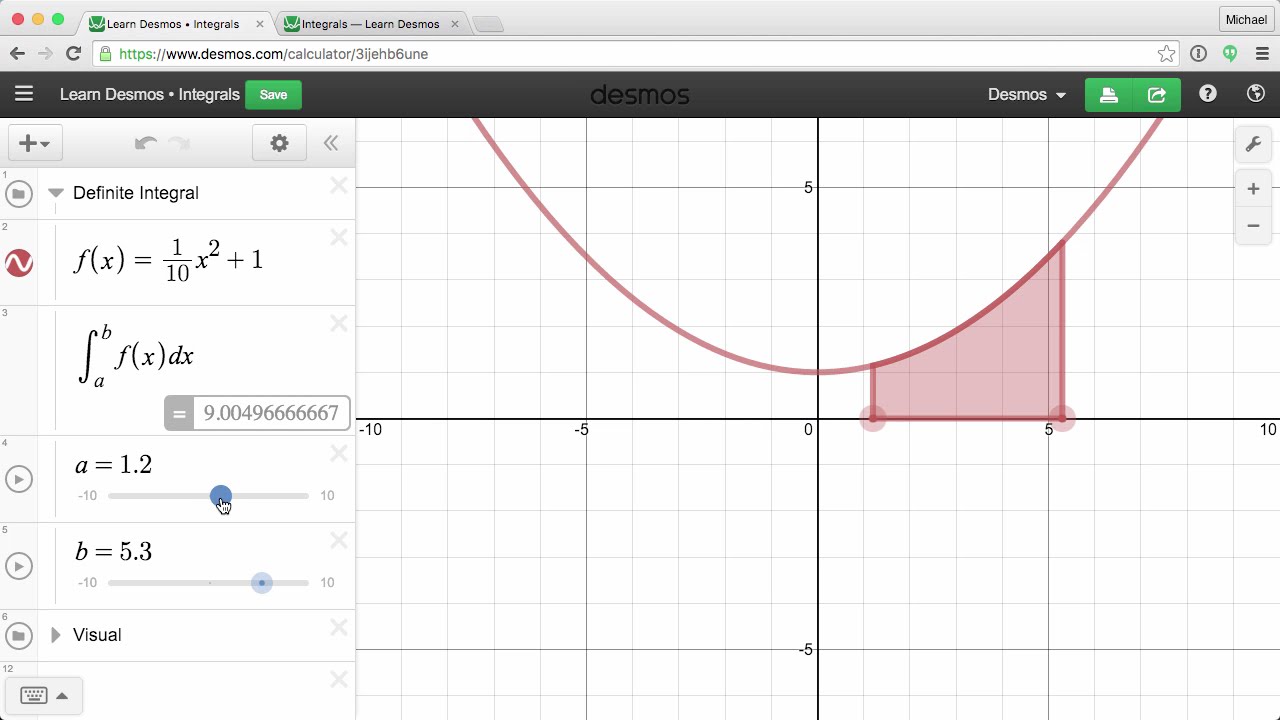
Integrals – Desmos Help Center
Also useful for the end of calculus 1. To find an antiderivative for a function f,. In other words, f is an antiderivative of f if f' = f. Now, this rule is one of the easiest antiderivative rules. Let f ( x) be continuous on [ a, b]. An antiderivative of a function f is a function whose derivative is f. Differentiate the function f + g. The graph linked here shows a whole family of. We sketch a very accurate graph of an antiderivative given the graph of its derivative. Since ( f ( x) + g ( x)) ′ = f ′ ( x) + g ′ ( x) = f ( x) + g ( x), it follows that f + g is an antiderivative of f + g.
Now in this video, we're going to look at a function and try to draw its antiderivative. Differentiate the function f + g. For example, if \(f(x) = x^2\text{,}\) its general antiderivative is \(f(x) = \frac{1}{3}x^3 + c\text{,}\) where we include the \(+c\) to indicate that \(f\) includes all of the possible. Find an antiderivative of the function f + g. If g ( x) is continuous on [ a, b] and g ′ ( x) = f ( x) for all x ∈ ( a, b), then g is called an antiderivative of f. The graph linked here shows a whole family of. To find an antiderivative for a function f,. Also useful for the end of calculus 1. In the answer for exercise 2, we saw how easy it is to make new antiderivatives out of old ones: Which sounds like a very fancy word, but it's just saying the antiderivative of a function is a.
Now in this video, we're going to look at a function and try to draw its antiderivative. To find an antiderivative for a function f,. The graph linked here shows a whole family of. Which sounds like a very fancy word, but it's just saying the antiderivative of a function is a. An antiderivative of a function f is a function whose derivative is f. Also useful for the end of calculus 1. If g ( x) is continuous on [ a, b] and g ′ ( x) = f ( x) for all x ∈ ( a, b), then g is called an antiderivative of f. Find an antiderivative of the function f + g. Now, this rule is one of the easiest antiderivative rules. When the antidifferentiation of the sum and difference of functions is to be determined, then we can do it by using the.
Let f ( x) be continuous on [ a, b]. We sketch a very accurate graph of an antiderivative given the graph of its derivative. For example, if , f ( x) = x 2, its general antiderivative is , f ( x) = 1 3 x 3 + c, where we include the “ + c ” to indicate that f includes all of the possible antiderivatives of. For example, if \(f(x) = x^2\text{,}\) its general antiderivative is \(f(x) = \frac{1}{3}x^3 + c\text{,}\) where we include the \(+c\) to indicate that \(f\) includes all of the possible. Differentiate the function f + g. Find an antiderivative of the function f + g. Since ( f ( x) + g ( x)) ′ = f ′ ( x) + g ′ ( x) = f ( x) + g ( x), it follows that f + g is an antiderivative of f + g. In other words, f is an antiderivative of f if f' = f. The graph linked here shows a whole family of. Which sounds like a very fancy word, but it's just saying the antiderivative of a function is a.
Now, this rule is one of the easiest antiderivative rules. In the answer for exercise 2, we saw how easy it is to make new antiderivatives out of old ones: Let f ( x) be continuous on [ a, b]. Which sounds like a very fancy word, but it's just saying the antiderivative of a function is a. We sketch a very accurate graph of an antiderivative given the graph of its derivative. When the antidifferentiation of the sum and difference of functions is to be determined, then we can do it by using the. For example, if \(f(x) = x^2\text{,}\) its general antiderivative is \(f(x) = \frac{1}{3}x^3 + c\text{,}\) where we include the \(+c\) to indicate that \(f\) includes all of the possible. In other words, f is an antiderivative of f if f' = f. An antiderivative of a function f is a function whose derivative is f. Differentiate the function f + g.